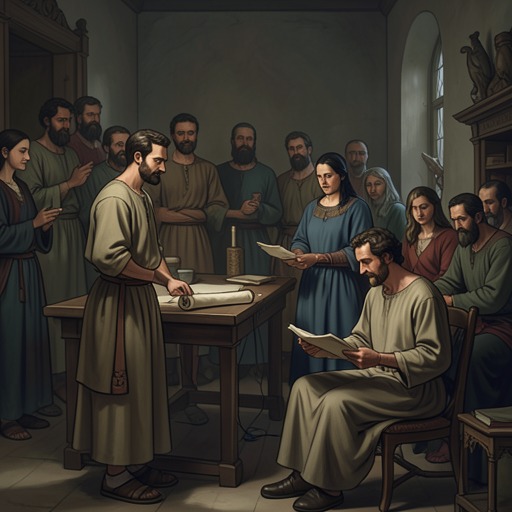
Jerusalem Council decides Gentile believers need not be circumcised
Acts of the ApostlesThe Jerusalem Council decides Gentile believers need not be circumcised, resolving a major dispute over who may belong to the community of the Realm and on what terms. The meeting gives collective theological authorization to the Gentile mission and frames Gentile inclusion not as a departure from Judaism but as an outcome grounded in Jewish tradition, scripture, communal experience, reason, and the Holy Spirit.
The question of belonging
The dispute arises after the Gentile mission has gained ground without yet receiving the church’s collective authorization or a clear account of what Jewish practice Gentile converts must adopt. Some believers from Judea go to Antioch asserting that Gentiles must be circumcised to be saved. Their claim makes circumcision a condition both for present membership in the community and for inclusion in the Realm after the apocalypse. At stake is whether Gentiles must be fully initiated into Judaism before they can belong.
Paul and Barnabas debate the visitors, after which the Antioch church appoints a delegation to discuss the matter with the apostles and elders in Jerusalem. The dispute is not treated as a minor local disagreement: Luke presents the Jerusalem meeting as a pivotal step in completing the authorization of the Gentile mission and clarifying its terms. The book prefers the name Jerusalem Council to apostolic council, because more people than apostles take part.
Deliberation and testimony
The council begins with extensive debate, a form of direct exchange characteristic of Jewish life at the time. Luke’s account then builds its case through several kinds of testimony. Peter, a respected leader of the Jerusalem community, recalls that God chose him to initiate the Gentile mission. He reports that God gave Gentiles the Holy Spirit just as God gave the Spirit to Jewish believers, and that God made them clean. His account presents Gentile inclusion as something God has already enacted, not merely a policy the council is free to invent.
Paul and Barnabas add their own eyewitness accounts. Their testimony connects the council’s deliberation to the developments of the mission beyond Jerusalem. James then interprets scripture, relating the Gentile experience to Amos 9:11–12 and arguing that God had long planned to welcome Gentiles into the community. His description of Gentiles becoming a people for God’s name also echoes language Luke uses for Israel. On this reading, God’s welcome of Gentiles adds them to the purposes of Israel rather than displacing Israel.
James’s reasoning is presented as faithful to Jewish tradition. The council does not turn away from Judaism; it turns Gentiles toward a Jewish framework for life together. Experience, scripture, reason, and the Holy Spirit work together in the argument. The decision therefore rests neither on institutional authority alone nor on a rejection of inherited practice, but on interpreting the Gentile mission within the continuity of Israel’s story.
The decision and its practical terms
James reaches a conclusion, and the Jerusalem congregation and the Holy Spirit endorse it. The council sends a letter to the church at Antioch and commissions a delegation to accompany Paul and Barnabas in carrying the decision. This procedure makes the outcome communal and communicable: it is delivered to the church facing the dispute, with representatives to convey it, rather than remaining an unreported judgment in Jerusalem.
The letter does not require Gentiles to be circumcised or to convert fully to Judaism. It does, however, ask them to adopt four practices associated with Jewish identity and life: abstaining from food offered to idols, from blood, from meat from strangled animals, and from sexual immorality. The book explains these requirements as a Jewish core for Gentiles: they guard against idolatry and make aspects of Jewish dietary practice available to Gentile believers.
These practices also address a practical consequence of inclusion. By setting shared expectations around food and conduct, the decision is meant to make it possible for Jewish and Gentile people to eat together in the community of the Realm. The council thus answers more than the abstract question of whether Gentiles may join. It gives terms for a common life in which difference does not require complete conversion on one side or exclusion on the other.
A Jewish basis for Gentile inclusion
The decision is placed within a long Jewish discussion of how people beyond Israel may live faithfully. The book links it to the promises made to all peoples in Genesis and to prescriptions in Leviticus that enabled Gentiles to live near Israel. It also recalls Jewish communities in the Hellenistic age that envisioned a place for righteous Gentiles in the world to come, including principles later known as the Noahide laws. Against this background, the council’s requirements are not an independent Christian formulation detached from Judaism; they participate in a wider Jewish account of Gentile belonging.
The episode marks a transition from informal approval of the Gentile mission to its collective authorization, while preserving continuity with Israel’s tradition. Its resolution does not erase the difference between Jewish and Gentile believers. Instead, it declines to make circumcision the threshold of membership and establishes practices intended to sustain fellowship across that difference. The council’s defining achievement is therefore both theological and communal: Gentiles are welcomed without first becoming Jews, and their welcome is given a Jewish shape that supports shared participation in the community of the Realm.